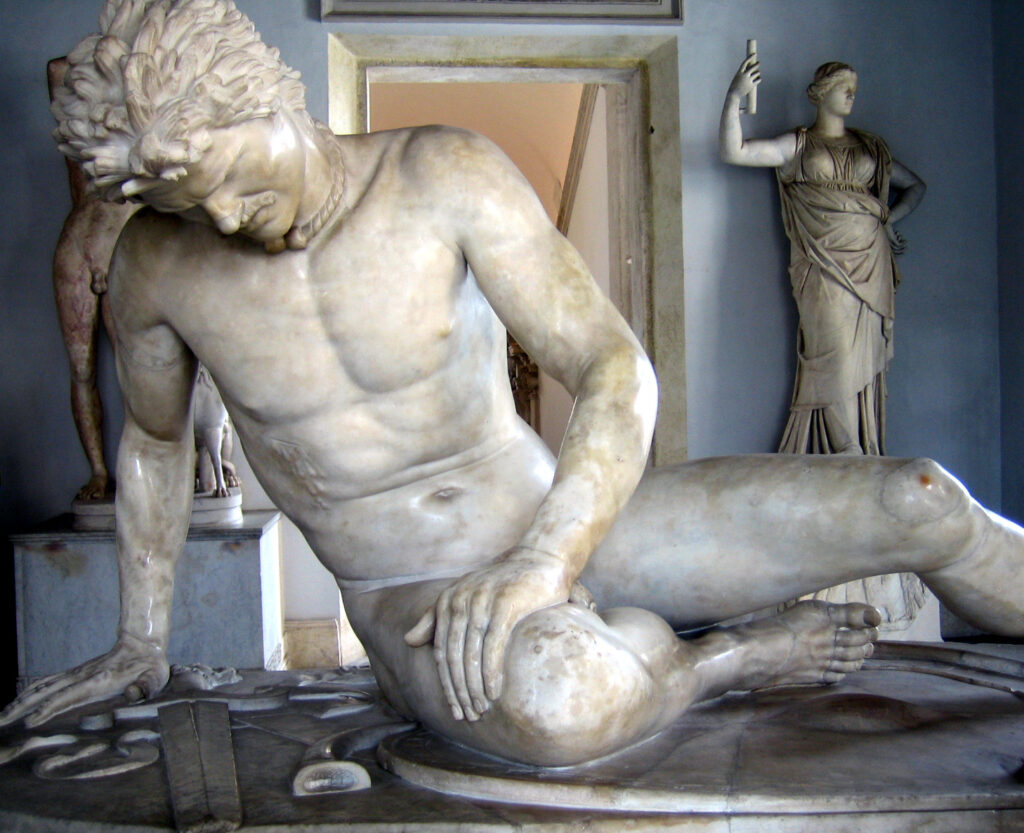
Sculpture occupies space rather than hanging on it, so a room must accommodate volume, weight and the viewer’s path around the work. A painting asks for wall and light; a sculpture asks for floor, clearance and patience. This essay looks at what that means in an ordinary house.
Why Sculpture Demands More Room Than a Painting
A painting is a window. Even a large canvas announces itself from one side and leaves the rest of the room free. A sculpture, by contrast, is an object with presence in three dimensions. It blocks sightlines, casts shadows that move across the day, and insists on being seen from several angles. Hang a painting slightly off-center and few visitors notice. Place a sculpture two inches too close to a doorway and every person who passes feels the error in the body.
That physical insistence changes the social life of a room. A sofa can face a painting; a sculpture demands a circuit. Guests do not stand still before it, they circle it, lean in, step back. The piece becomes a small theater of movement rather than a fixed image. This is why collectors often say that sculpture “owns” a room in a way painting does not: it rewrites the geometry of the space around it.
Scale, Weight and Floors
Scale in sculpture is not just height. A figure of human size can feel monumental if it is dense, dark and set on a plinth; a small work can feel vast if it sits alone on a long table with nothing else near it. The lesson for a private home is that volume matters more than measurements on a spec sheet. A bronze of modest height may weigh hundreds of pounds and ask for a reinforced plinth or a ground-floor position. Marble is heavier still and less forgiving of vibration, so a sculpture on an upper floor needs a structural check before it is ever lifted into place.
Floors tell their own story. Old timber boards flex; stone does not. A heavy work on a springy floor will creak and shift, and the base will slowly work loose. Practical owners handle this with simple habits:
– Place heavy pieces on ground floors or directly above load-bearing walls – Use a solid plinth or base that spreads the load – Keep felt or rubber pads under small bronzes to protect wood – Leave a margin of empty floor around the work for cleaning and safety
Weight also affects insurance and moving. A sculpture that took three people to install will take three to move, and a house that changes owners may need to plan for that. The piece is not furniture; it cannot be shifted for a party and returned the next morning.
Light and the Walk Around
Light on sculpture is a different problem from light on painting. A painting wants even, soft illumination that reveals color without glare. A sculpture wants light that models form: raking light across a carved face, a single source that throws one strong shadow, or diffuse daylight that lets the material speak. The same bronze can look dull under flat ceiling light and alive under a window at four in the afternoon.
This is why placement is usually tested at several times of day. A white marble figure near a south window may glow at noon and disappear into glare; a dark patinated bronze in the same spot may read as a silhouette. Owners learn to live with these changes rather than fight them. A piece that looks different at breakfast and at dusk is not a failure of lighting, it is the work doing what sculpture does.
The walk around matters as much as the light. A sculpture seen only from the front is half a sculpture. Rooms that allow a slow circuit, even a narrow one, give the work its full life. A piece pressed against a wall becomes a relief; a piece given even eighteen inches of clearance on all sides becomes a volume again. In small houses this often means choosing one corner for the sculpture and accepting that the corner now belongs to it.
Gardens and the Outdoor Piece
An outdoor sculpture lives under a different contract. It must survive rain, frost, UV light and the slow chemistry of moss and lichen. Bronze develops a patina that many owners prize; marble weathers and loses detail; steel rusts unless it is treated. The choice of material is therefore a choice about how much change one is willing to accept.
Gardens also change the scale of a work. A figure that dominates a living room can vanish against a hedge of yew. Outdoor pieces are usually larger, simpler in silhouette and placed where a long view is possible: at the end of an allée, beside water, or against a plain wall that acts as a backdrop. The garden becomes a gallery with no ceiling, and the weather becomes part of the display.
There is a practical side too. A sculpture in a garden needs a foundation, drainage and a plan for winter. Leaves and soil collect at the base and hold moisture against the material. Birds nest in hollows. Owners who maintain an outdoor piece spend a little time each season with a soft brush and water, and they know which surfaces need wax or sealant.
How a Sculpture Changes Movement at Home
The deepest effect of living with sculpture is not visual but kinetic. A house with a sculpture in it is walked differently. People slow down at the piece, circle it, touch it if allowed, and route their daily paths around it. Children grow up measuring themselves against a bronze figure; guests remember the house by the object in the hall. The sculpture becomes a landmark inside the domestic map, the way a tree is a landmark in a garden.
This changes furniture too. A room with a central sculpture cannot hold a large coffee table in the same spot. Traffic patterns shift. The piece teaches the household a new choreography, and over years that choreography becomes invisible habit. Owners stop seeing the sculpture as an object they own and start seeing it as a feature of how the house lives.
Living with sculpture is therefore less about taste than about commitment. It asks for space, structure, light and patience, and it returns a presence that no painting can match. The reward is not decoration but company: a solid, silent, three-dimensional fact that shares the room with the people in it.